Saturday, November 7, 2009

The Urban Botanist

Year 3, semester 2
Final work presented in SITE 09 at the Dunedin School of Art prior to graduation.

To glean is to make effective use of waste or leftovers. We are a society that consumes more resources than the planet can generate. By gleaning waste materials from a disposable consumer culture, the work engages in regeneration of newspapers and found metal objects.

The cultivation of this project explores the process of collage and screenprinting, allowing me to excavate urban detritus and encapsulate an archive of civilisation. Works challenge the notion of value placed on consumer waste.

The urban botanist endeavors to supplant the value and meaning of waste into objects of display. Urban detritus adopts renewable, organic form.

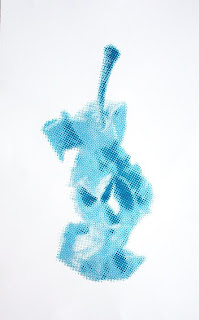
The Urban Botanist - Crooked, 2009
collage & screenprint on newspaper 598 x 420 mm

Newspaper is glued using flour paste like posters pasted around the city. The layers are cut or torn, uncovering text and colour that exists on the page becoming a collapsed collage. Text provides titles for the work while commenting on current topics relating to our consumer society revealing a palimpsest of diverse layers beneath the surface.

Found flat metal discs, the detritus of urbanisation and industrialisation, are used in the screen print process to overlay the surface of the paper, inverting the décollage process to further disrupt original meaning.

The newspaper is dried slowly, creating an abstract, multi layered form under tension, curving and buckling of its own accord. The work regenerates a former existence, appearing as tree bark into a hybrid of urban botany, containing traces of urban identity.

Wunderkammer I, 2009,
mixed media on paper,

In the reclamation of metal objects, the discovery of paint surfaces blistering and peeling like bark from exposure to the elements experiences another transformation in the gleaning process. These paint layers reveal on the underside, colours, patterns and textures, providing a surrealist landscape for décollage of the discarded into objects of art to complement the newspaper work. This work uncovers a connection to the Wunderkammer, or cabinets of curiosity, the sense of wonder exposed from paint layers on discarded metal objects, originating as cabinets, challenging the classification of their worth.

This work exposes the printmaker who allows nature to offer the print. It has the same feeling as in the workshop when you peel the paper off the plate after rolling through the press for the first time, revealing one of those happy accidents.

SITE 09 display - 15 units on a narrow shelf

SITE 09 Wunderkammers

3000 word essay

Year 3, semester 1, essay 3

Contextualising my current art practice - excerpt

My current body of work in printmaking relates to a project involving the apple, the multiple and screenprinting, merging art, life and science. Through exploration and research I am looking at the subject of gleaning. The initial idea has evolved through my interest in self sufficiency. The concern for the depletion of fossil fuels, their impact on the environment through globalisation, food miles and the search for alternative energy has led me to investigate the role of the wilding apple trees. These grow on our roadsides producing apples that generally go to waste. Apples have the potential of becoming an alternative fuel in the form of alcohol, a project that is currently of interest to my partner, through which I am also involved.

With regard to gleaning, a major art historical reference is the painting titled The Gleaners by Jean Francois Millet. This work, depicting women in a field gleaning grain after the harvest, represents peasant life and contemporary social conditions. There is a powerful physical expression and poignancy in this work that signifies his concern for mankind, particularly an empathy with the poor or lower class. The women in Millet's painting are gleaning grain, however, it is the subject of crops not utilised for harvest, food that goes to waste, that is of interest to me.

Daniel Quinn in Beyond Civilization stated that making food a commodity to be owned was one of the great innovations of our culture. No other culture in history has ever put food under lock and key – and putting it there is the cornerstone of our economy, for if the food wasn't under lock and key who would work?1 In today's capitalist climate, this statement implies the fate of our troubled global economy. Quinn doesn't provide an answer, instead encourages us to become engaged in the world, and change our way of thinking in our working environment.

Jean Francois Millet, The Gleaners

Jelly label
1 Daniel Quinn. Beyond Civilization New York; Three Rivers Press. 1999, p5

Art & Language

Year 3, semester 1, essay 2

Excerpt
Seeing comes before words. The child looks and recognises before it can speak.1
Seeing establishes our place in the world. To communicate what and how we see we need a language. As a child, one way I learned about language was through illustrated picture books that combine alphabet, word and image. As I grew and gained a broader understanding of language through books, the images decreased. As an artist, I feel I am returning to the idea of the illustrated picture book, so that I may communicate my thoughts and ideas. By verbalising the visual, I engage in communication with other human beings, so they may see what I see. Language is the key for our understanding of art. Language also influences our perception of the world. This essay will explore the relationship between art and language to human beings, through perception and semiotics to enable me to contextualise my current art practice in printmaking.

Understanding language is the key to understanding or making sen se of things. The human life world is a world in which human beings are engaged with others. Through language, human beings are engaged in a world of meanings.

This sentence highlights our need to understand written language. By using Webdings, a dingbat font that renders letters as symbols, I imagine this sentence is meaningless to anyone untrained in the interpretation of Webdings.

Understanding language is the key to understanding or making sense of things. The human life world is a world in which human beings are engaged with others. Through language, human beings are engaged in a world of meanings.2

For me, art is a visual language. Conceptual art has opened the door to artistic freedom, engaging with others in the human life world. Artists can, through intersubjectivity in a shared world, express concerns that affect their social environment. The search for a better way of life is expressed in my work, through concerns for the care and protection of my children. I consider social issues, ranging from human impact in the global and local environment, to issues regarding consumption and sustainability. Works I reference, will be analysed in a social context as this has a bearing on my work, to allow you to see what I see.


1 John Berger. Ways of Seeing. London: Penguin Books, 1972 p7
2 This sentence is the translation of the Webdings version

Warhol

Year 3, semester 1
Why ARE We Still Talking About Andy Warhol?
This essay focuses on the theme of repetition. According to Arthur C Danto, the pop artist reproduced as high art what everybody knew – the familiar things of the ordinary person's life world: comic strips, soup cans, shipping cartons, cheeseburgers.1

What are the connections with repetition and the familiar? For Andy Warhol, the embodied meanings of his works belonged to the common culture of the time and were recognised as a part of every day life. What effect does the repetition of the familiar have on a human being?

The concepts addressed in this essayl involve research into:
• Introduction to pop art.
• Repetition in art
• Analysis of a work by Warhol.
• Analysis of work involving repetition by a contemporary artist.
• Comparing and contrasting these works.
• Psychology and repetition.
• Repetition and the role it plays in the human life world.

Excerpt
Repetition is with us from birth. As a baby, we live in a cyclical environment, a rhythm of life. We should be provided with warmth, nourishment and order. As we grow, we are taught by repetition to use the toilet and to talk. Repetition of words such as mama or daddy mean we have a language that we can associate with certain objects. We remember nursery rhymes and counting games through constant repetition. Our early upbringing in the world is a series of repetitions, and for most is a memory of happy times. For some less fortunate, childhood can bring back memories of abuse, a topic exposed through media frequently today.
Warhol's soup cans are represented as comfort food, a product of his everyday life and a packaged commodity. In contrast to the soup cans, Warhol also produced works relating to appropriated images in mass media production. An important body of work is the Death in America series based on newspaper photographs of car crashes, suicides, the electric chair and civil rights confrontations. These works use repetition of images based on Warhol's comment:
“When you see a gruesome picture over and over again, it doesn't really have any effect. The more you look at the exact same thing, the meaning goes away, and the better and emptier you feel.”2
This emptiness reflects consumer culture of the pop era through the saturation of mass media in television, newspapers and magazines. We become immune or de-sensitised to visual imagery through constant repetition in the mass media.

Through repetition of familiar, everyday objects, Warhol has responded to social and political conditions of popular culture in the 1960's. The works of Renee Green and Willie Cole also respond to social and political conditions facing us here and now. Their use of repetition and familiar objects, reiterates the many layers of meaning, understood through a common language, that a work of art can reveal to the viewer, rather than being viewed passively. The audience is a critical issue to consider for a socially and politically engaged artist. These works encourage the audience to consider their position in the world, and their engagement with other human beings.

1 Arthur Danto. Beyond the Brillo Box. New York; Noonday, 1992. 3
2 Hal Foster, The Return of the Real: the Avant-Garde at the End of the Century. Cambridge, Mass.; MIT Press, 1996 131

Tuesday, October 27, 2009

Gleaning apples

Year 3, semester 1 - Printmaking
Roadside, windfall apples became the focus of this project as an avenue to comment on consumption and sustainability through the concept of gleaning.
The technique of screenprinting was covered in our first workshop for the year, so I worked on an image of an apple core that has been digitally manipulated. Five layers of colour were used.

Also, with gleaning being my course for research, I made some gleaning bags using recycled newspaper.

With the abundance of apples available, I made apple jelly and used a manipulated image of Jean Francois Millet's painting, The Gleaners.

Sunday, October 25, 2009

Bronze casting

Year 2, semester 2, 2008
3 week elective
The process involved dipping several layers of casting sand over the wax mold

Exciting sensory experience watching, smelling and hearing the wax melt and burn out of the molds

The molten bronze pours into the molds

Bronze tells a lasting tale of cultures lost to time.
Bronze is also among the primary materials for sculpture because it is a classical, noble material. Bronze has a history.

I have looked at bronze works by Michele Oka Doner for their organic properties, and also Giuseppe Penone, whose work addresses the relationship between man and nature. According to Penone, the similarities between bronze and plant life are astonishing and must assuredly have great importance in the development of the technique of casting. In bronze, plant life preserves all of its appearance.... Penone uses bronze, not for its noble historical nature, but for its intrinsic properties, like an organism reacting to environmental conditions.

I have chosen to cast a bowl and spoon and through research have decided the function of my object is a salt cellar. Salt, like bronze also has a long history. Salt is associated with value and worthiness . The Bible has a reference; “Witness, we are the salt of the earth”. An important use of salt is as a preservative. One meaning of the expression salt of the earth is as asserting the duty to preserve the purity of the world. Another interpretation is that it orders the audience to take part in the world rather than withdraw from it.

Looking at Nicholas Bourriaud and his relational aesthetics, I want my work to create a social environment in which the audience comes together to participate in a shared activity. In many cultures, particularly in Eastern Europe, offering bread and salt is a customary form of welcome. By offering bread and salt to the audience, I am expressing environmental concerns. I have chosen not to add salt to the bread and want the audience to first of all pass the salt cellar around, each placing a small portion of salt into the palm of their hand and then helping themselves to the bread.

Bread without salt isn't very palatable, so by offering it in this way I am saying that many take the addition of salt for granted. Salt comes from our sea. The sea controls the planet, climate and water circulation. Destroy our sea through pollution, plunder and global warming and we have no future. Consider the state of our planet, don't take it for granted.

Eat this bread and be prepared to act to make it a better place for future generations.

Duchamp & Vernon Ah Kee

Essay- Year 2, semester 2 2008
Key texts - 1968 - present
Engaging in the World Around Us (excerpts)


Mankind is passing through the most profound crisis in its history. An old world is dying; a new one is being born. Capitalist civilisation, which has dominated the economic, political and cultural life of continents, is in the process of decay.
This quote, from the “John Reed Club of New York: Draft Manifesto” was originally published in New Masses in June 1932, but is just as relevant today in light of the current global, economic and environmental downturn affecting our communities. The work Fountain by Marcel Duchamp from 1917, was produced at a time when art was stimulated by intense creativity and experimentation in the period of Modernism. This was a time when avant-garde artists rebelled against traditional forms of art and rejected the bourgeois social structure of capitalism. With reference to the quote, this essay will explore issues of democracy and authenticity in the relationship of Fountain to a contemporary work by Vernon Ah Kee, titled Born in this Skin. I will discuss art, culture and political change over this time period. Emphasis will be on freedom of expression that resulted from Duchamp's ideas and the development of public art as a democratic voice. Vernon Ah Kee's work has had an impact on me, not only because I had the opportunity to experience the work as part of the Sydney Biennale but also to consider my own artistic development as an individual and where I locate myself as an artist in the 21st century. I believe Vernon Ah Kee was referencing Duchamp's Fountain in choosing the public toilet as a work of art. According to Grant Kester:
Arts role is to shock us out of perceptual complacency, to force us to see the world anew, to make the viewer more sensitive and responsive to the social world.1
I feel both Marcel Duchamp and Vernon Ah Kee have achieved this distinction of making us aware of the world we live in, a world in the process of decay.

1 Grant H Kester. “Conversation Pieces: The Role of Dialogue in Socially-Engaged Art (2004).” Theory in contemporary art since 1985. edited by Zoya Kocur and Simon Leung. Malden, MA ; Oxford, UK : Blackwell Publishing, 2005. 79