Showing posts with label printmaking. Show all posts

Monday, October 18, 2010

Plenty

Women on Form Group Exhibition at Rocda Gallery 4th - 16th October

This show, part of the 2010 Otago Arts Festival, involves thirteen women exploring the theme of jugs, vessels, bodies.


My three prints are inspired by art historical references that have played a part in my journey of discovery in these last 4 years at art school.


For Braque, etching, emboss, collage


For Magritte, silkscreen


For Bourgeois, etching

Tuesday, September 21, 2010

4sight exhibition

Printmaking exhibition 10 - 17 September 2010
22 senior students and lecturers from Dunedin School of Art.

This show was a trial run for graduating students taking part in SITE10


Image shows a reconstructed drain made from recycled newspaper and a framed silkscreen of an urban oasis also on recycled newspaper.


Dappled sunlight was rippling across image accentuating the foliage.


The start of an expanding drainage system that I hope to install in the gallery at the end of year exhibition.

Sunday, September 12, 2010

OUSA Art Week

August 2010
An installation in poster boxes (formerly where exam results were posted) in the beautiful old archway building of Otago University.


Just need the broomstick for a game of quidditch!


Works from the 2009 Urban Botanist series and screenprints on handmade recycled newspaper.


Monday, July 12, 2010

Urban Botany Year 4 Semester 1


This 'found' image of Palm Jumeirah, Dubai, seen in the National Geographic has sparked this years project. Palm Jumeirah is a man-made island formed in the shape of a cultural icon, the palm tree. For me, the palm tree symbolises warm, tropical island holidays while also conjuring an image of a fertile oasis, a refuge. Research looks at man's manipulation of the environment and infrastructure dealing with utility services such as water supply, sewerage and wastewater.

This quote from Dorothy Sayers in 'Why Work' , struck a chord.

A society in which consumption has to be artificially stimulated in order to keep production going is a society founded on trash and waste, and such a society is a house built upon sand.

My interpretation of Sayers' quote echoes the impact of wasteful consumption today. Artificial stimulation could very easily refer to the effects of the superficial, man-made urban metropolis, where population growth and consumption place huge demands on this hedonist oasis.

The urban botanist experiences the city. So how does Palm Jumeirah form an alliance with a local, lived experience here in Dunedin? The association of Palm Jumeirah to the oasis, and reclamation both of the land and in recycling of materials, generate notions of the act of draining in a transforming and transient landscape.

Newspaper is pulped and transformed into handmade paper with fragments of the newspaper visible and partially legible. Also, in recycling newspaper, layers are built up through collage, deleting or exposing bold text in the manner of pasted city posters. The newspaper dries, taking on the form of cylinders or tubes representing drains. Newspaper joiners are made creating a network of interconnecting drains.


Drains imply dirt - waste – abjection. Robert Gober's work, with his use of sinks, urinals and drains is Abject. These mundane objects present us with the banalities of life that according to Gober, flow beneath the everyday.

The relationship between abjection and the botanist is explored in studio practice through an urban inquisition in what is often regarded as repulsive - the socially less presentable function of drainage systems. Drains in the urban landscape are neglected, somewhat obscured vessels of waste facilitating effective disappearance of human presence. The regular, labour intensive process of papermaking in the studio has become a ritualistic undertaking, like daily ablutions of flushing and draining. The handmade paper incorporates shredded newspaper, disintegrated fragments of daily news, a palimpsest, blending into a mid-tone grey colour suggesting an urban, man-made landscape of concrete and asphalt.

Photographs record and document urban drains where weeds persist in waste spaces of the cultivated milieu, fertile urban oases. Manipulated into b/w images for screenprinting on handmade paper, a chiaroscuro effect, integrating a relationship between the creative process of reclaiming newspaper and prosaic imagery celebrates the overlooked.


Samples of photographs using the infra red filter to accentuate the plant life.


Transformed into black and white screen prints using mid tone grey hand made paper.
Size approximately A3

Saturday, November 7, 2009

The Urban Botanist

Year 3, semester 2
Final work presented in SITE 09 at the Dunedin School of Art prior to graduation.

To glean is to make effective use of waste or leftovers. We are a society that consumes more resources than the planet can generate. By gleaning waste materials from a disposable consumer culture, the work engages in regeneration of newspapers and found metal objects.

The cultivation of this project explores the process of collage and screenprinting, allowing me to excavate urban detritus and encapsulate an archive of civilisation. Works challenge the notion of value placed on consumer waste.

The urban botanist endeavors to supplant the value and meaning of waste into objects of display. Urban detritus adopts renewable, organic form.

The Urban Botanist - Crooked, 2009
collage & screenprint on newspaper 598 x 420 mm

Newspaper is glued using flour paste like posters pasted around the city. The layers are cut or torn, uncovering text and colour that exists on the page becoming a collapsed collage. Text provides titles for the work while commenting on current topics relating to our consumer society revealing a palimpsest of diverse layers beneath the surface.

Found flat metal discs, the detritus of urbanisation and industrialisation, are used in the screen print process to overlay the surface of the paper, inverting the décollage process to further disrupt original meaning.

The newspaper is dried slowly, creating an abstract, multi layered form under tension, curving and buckling of its own accord. The work regenerates a former existence, appearing as tree bark into a hybrid of urban botany, containing traces of urban identity.

Wunderkammer I, 2009,
mixed media on paper,

In the reclamation of metal objects, the discovery of paint surfaces blistering and peeling like bark from exposure to the elements experiences another transformation in the gleaning process. These paint layers reveal on the underside, colours, patterns and textures, providing a surrealist landscape for décollage of the discarded into objects of art to complement the newspaper work. This work uncovers a connection to the Wunderkammer, or cabinets of curiosity, the sense of wonder exposed from paint layers on discarded metal objects, originating as cabinets, challenging the classification of their worth.

This work exposes the printmaker who allows nature to offer the print. It has the same feeling as in the workshop when you peel the paper off the plate after rolling through the press for the first time, revealing one of those happy accidents.

SITE 09 display - 15 units on a narrow shelf

SITE 09 Wunderkammers

3000 word essay

Year 3, semester 1, essay 3

Contextualising my current art practice - excerpt

My current body of work in printmaking relates to a project involving the apple, the multiple and screenprinting, merging art, life and science. Through exploration and research I am looking at the subject of gleaning. The initial idea has evolved through my interest in self sufficiency. The concern for the depletion of fossil fuels, their impact on the environment through globalisation, food miles and the search for alternative energy has led me to investigate the role of the wilding apple trees. These grow on our roadsides producing apples that generally go to waste. Apples have the potential of becoming an alternative fuel in the form of alcohol, a project that is currently of interest to my partner, through which I am also involved.

With regard to gleaning, a major art historical reference is the painting titled The Gleaners by Jean Francois Millet. This work, depicting women in a field gleaning grain after the harvest, represents peasant life and contemporary social conditions. There is a powerful physical expression and poignancy in this work that signifies his concern for mankind, particularly an empathy with the poor or lower class. The women in Millet's painting are gleaning grain, however, it is the subject of crops not utilised for harvest, food that goes to waste, that is of interest to me.

Daniel Quinn in Beyond Civilization stated that making food a commodity to be owned was one of the great innovations of our culture. No other culture in history has ever put food under lock and key – and putting it there is the cornerstone of our economy, for if the food wasn't under lock and key who would work?1 In today's capitalist climate, this statement implies the fate of our troubled global economy. Quinn doesn't provide an answer, instead encourages us to become engaged in the world, and change our way of thinking in our working environment.

Jean Francois Millet, The Gleaners

Jelly label
1 Daniel Quinn. Beyond Civilization New York; Three Rivers Press. 1999, p5

Tuesday, October 27, 2009

Gleaning apples

Year 3, semester 1 - Printmaking
Roadside, windfall apples became the focus of this project as an avenue to comment on consumption and sustainability through the concept of gleaning.
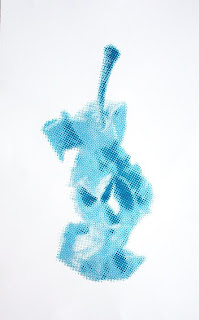
The technique of screenprinting was covered in our first workshop for the year, so I worked on an image of an apple core that has been digitally manipulated. Five layers of colour were used.

Also, with gleaning being my course for research, I made some gleaning bags using recycled newspaper.

With the abundance of apples available, I made apple jelly and used a manipulated image of Jean Francois Millet's painting, The Gleaners.

Sunday, October 25, 2009

Print major

Year 2, semester 2, 2008


This body of work relates to a song by Patsy Cline - If I Could See the World Through the Eyes of a Child. I used imagery that related to the song. For me, with the song title going on to say "what a wonderful world that would be", I thought of children who have no choice but to go through war, their innocence lost.
With the idea of media to convey my message, I used newspaper, a wide format image representing the widescreen TV, and a reproduction of a record cover to display my works.


Monday, October 12, 2009

Printmaking Part 2


Colour and stencils were the order of the day with the project having the title Chromophobia. Layered stencils and color combinations were explored to familiarise us with using colour and rolling ink onto woodblocks. Lots of fun!

Printmaking part 1


Protest was one stage of our assignment in the print department. With the recent recall of toys made in China, I decided to focus my attention on the barbie doll. Maid in China drew attention to child labour and sweatshops.